
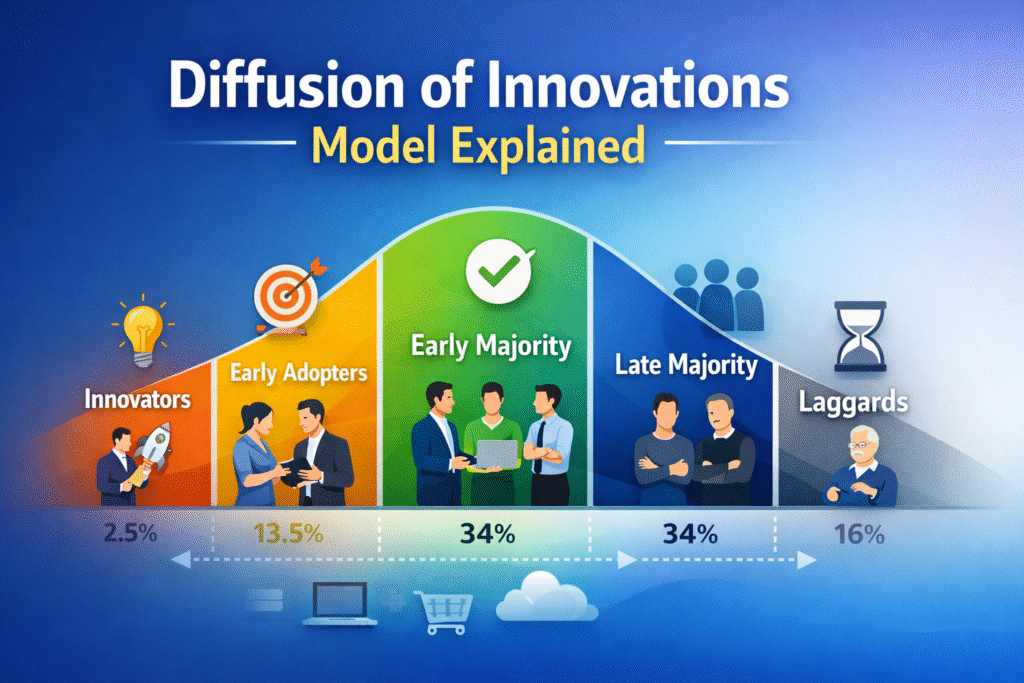
The Diffusion of Innovations model explains how new ideas, products, and technologies spread through a market over time. Rather than focusing on how good an innovation is, the model focuses on how people behave when they are confronted with something new. That distinction is what makes the framework so valuable for marketers, product strategists, and founders.
From a strategic perspective, the Diffusion of Innovations model helps you understand why early traction does not automatically lead to mass adoption, why some launches stall after initial excitement, and why marketing messages lose effectiveness as products mature. This article explains the model in depth and shows how it can be applied to marketing, product adoption, and growth strategy across digital products, SaaS, e-commerce, and technology-driven businesses.
What the Diffusion of Innovations model actually explains
At its core, the Diffusion of Innovations model explains how adoption spreads through a population in phases. People differ in how they perceive risk, how much uncertainty they tolerate, and how much social proof they need before taking action. These differences create predictable patterns in how innovations are adopted over time.
The model divides adopters into five groups: Innovators, Early Adopters, Early Majority, Late Majority, and Laggards. Each group represents a distinct way of thinking about change. The strategic value of the model lies in recognizing that no single message, channel, or positioning works equally well for all five groups.
Why adopter behavior matters more than demographics
A common mistake is treating adopter groups as demographic segments. In reality, adoption behavior is situational. The same person may be an Innovator when it comes to software tools, an Early Majority adopter in e-commerce platforms, and a Late Majority adopter in financial products.
This means the model is not about labeling people, but about understanding context. For marketers, this shifts the focus from who your audience is to how your audience evaluates risk, usefulness, and credibility in a specific category.
Innovators: adoption driven by curiosity and access
Innovators are the first group to adopt an innovation. They are motivated by curiosity, experimentation, and technical interest rather than immediate practical value. Innovators accept incomplete products, limited documentation, and unclear positioning as part of the process.
From a marketing perspective, Innovators respond to access rather than persuasion. Early betas, sandbox environments, and transparent product roadmaps are more effective than benefit-driven messaging. The strategic limitation is that Innovators are few in number and rarely represent sustainable demand.
Early Adopters: adoption driven by advantage and vision
Early Adopters adopt because they believe an innovation gives them a meaningful advantage. They care less about experimentation and more about how a product helps them move ahead of peers or competitors. This is where positioning becomes critical.
Messaging that emphasizes vision, differentiation, and future potential resonates strongly at this stage. However, Early Adopters tolerate uncertainty that later groups will not. Assuming their enthusiasm predicts mainstream readiness is one of the most common causes of stalled growth.
The strategic problem between Early Adopters and the Early Majority
The transition from Early Adopters to the Early Majority is the most fragile point in the Diffusion of Innovations model. Early Adopters are willing to take risks in exchange for advantage. The Early Majority is not. They prioritize reliability, proof, and compatibility with existing workflows.
When marketing continues to focus on vision and disruption at this stage, it creates friction instead of momentum. The challenge is not awareness, but trust. Many products fail here because messaging evolves too slowly while expectations change quickly.
Early Majority: adoption driven by proof and practicality
The Early Majority adopts once an innovation feels safe and proven. They look for evidence that the product works for people like them. Case studies, reviews, comparisons, and clear onboarding matter more than novelty.
This is the phase where marketing and operations become tightly linked. Poor onboarding, weak documentation, or inconsistent support can block adoption even when demand exists. Growth here is less about persuasion and more about removing friction.
Late Majority: adoption driven by necessity
The Late Majority adopts because the innovation has become the standard. Their motivation is often external pressure, cost efficiency, or fear of being left behind. Enthusiasm is low, and skepticism is high.
Marketing at this stage focuses on reassurance, risk reduction, and support rather than differentiation. Strategically, margins often shrink here, and growth depends more on operational efficiency than creative messaging.
Laggards: resistance shaped by context
Laggards adopt last, if at all. Their resistance is often rooted in habit, distrust, or structural constraints rather than lack of awareness. In many markets, they are not a priority for growth-focused teams.
In regulated or infrastructure-heavy industries, however, Laggards may eventually be forced to adopt. In those cases, education and compliance-driven communication becomes more relevant than competitive positioning.
Using the model to plan product launches
Applying the Diffusion of Innovations model to product launches requires sequencing rather than scale-first thinking. Early-stage launches benefit from limited exposure, fast feedback, and flexible positioning.
A strategic mistake is locking messaging too early. What works for Early Adopters often fails for the Early Majority. Planning for message evolution from the start reduces the risk of hitting a growth ceiling later.
How the model applies to SaaS and digital products
SaaS and digital products often move quickly through early adoption phases because switching costs are low and experimentation is easy. This speed can hide the moment when adopter expectations change.
High sign-up numbers do not automatically indicate readiness for mainstream adoption. Retention, activation, and support maturity are better indicators of whether a product is ready to move beyond early-stage growth.
Diffusion dynamics in e-commerce and platforms
In e-commerce, diffusion often happens at the feature level rather than the platform level. Innovations such as new checkout flows or personalization tools are adopted unevenly across merchants.
Early adopters experiment, while the Early Majority waits for proven return on investment. Marketing strategies that combine education with concrete proof tend to outperform broad announcements.
Examples of diffusion patterns in practice
Many widely adopted technologies followed classic diffusion patterns. Early excitement was driven by niche users, followed by a period of stagnation, and then rapid mainstream uptake once standards and trust were established.
These patterns show that successful growth is rarely about accelerating adoption unnaturally. It is about aligning product maturity, messaging, and expectations at each stage of adoption.
Limits and risks of the Diffusion of Innovations model
The Diffusion of Innovations model simplifies reality. Adoption does not always follow smooth curves, and external factors such as regulation, platforms, or network effects can disrupt expected patterns.
Used without nuance, the model can create false confidence. Its value lies in guiding strategic questions, not predicting exact timelines or outcomes.
Using the model as a strategic lens
The Diffusion of Innovations model works best as a diagnostic tool. When growth slows, it helps identify whether messaging still matches adopter motivation. When launches underperform, it highlights sequencing problems rather than execution flaws.
For marketers and strategists, the model encourages adaptation over repetition. Understanding where your product sits in the adoption curve clarifies what needs to change next.
Frequently Asked Questions
What is the Diffusion of Innovations model used for in marketing?
It is used to understand how different groups adopt new products over time and how marketing strategies should evolve as adoption progresses.
Why is the transition to the Early Majority so difficult?
Because the Early Majority requires proof, reliability, and social validation, while earlier adopters accept uncertainty.
Can the model be applied to SaaS products?
Yes. It is especially useful for SaaS, where early traction often does not translate directly into mainstream adoption.
Does every innovation reach all five adopter groups?
No. Many innovations fail before reaching mainstream adoption or remain limited to niche audiences.
Is the Diffusion of Innovations model still relevant today?
Yes. While channels and speed have changed, the underlying human behaviors that drive adoption remain consistent.