
Many marketing teams believe their strategy is sound because personas are well defined, channels are mapped, and dashboards look convincing. Yet positioning still feels interchangeable, messaging fails to resonate, and growth stalls in competitive markets. The recurring mistake is assuming that understanding who the customer is automatically explains why they choose one solution over another.
The Jobs To Be Done framework reframes this problem at its root. Instead of starting with customer profiles, it starts with situations where people try to make progress and “hire” products or services to help them do so. From a strategic marketing perspective, the Jobs To Be Done framework is not a persona replacement or research shortcut, but a decision lens for positioning, messaging, content, and product choices.
Why persona-based marketing often fails
Personas promise clarity by grouping customers into recognizable profiles, but they rarely explain actual buying behavior. Knowing that a buyer is a “mid-level marketing manager in a SaaS company” does not reveal what triggered their search, what alternatives they weighed, or what progress they wanted to make. Personas describe people, not decisions.
The strategic limitation of personas is not lack of detail, but lack of causality. In competitive markets, multiple brands target the same persona with nearly identical messages. Teams respond by refining demographics or adding attributes, which increases complexity without improving insight. The real decision moment is when a customer decides to change something, not when they fit a profile.
- Personas overemphasize identity instead of situation.
- They explain who buys, not why they switch or adopt.
- They encourage surface-level differentiation.
Core principles of Jobs To Be Done
At its core, Jobs To Be Done reframes markets around the progress people seek in specific circumstances. Customers are not buying products for their features; they are “hiring” solutions to resolve a tension between their current state and a desired future state. A job exists independently of any product or brand.
This reframing forces a strategic choice. Teams can compete on product attributes, or they can compete on relevance to a situation. Organizations that choose the latter identify recurring patterns of struggle and motivation, then align offerings to those moments. The implication is clear: innovation and messaging start with context, not category.
- Jobs are stable over time, products are not.
- Situations create demand, not awareness alone.
- Progress includes functional and non-functional outcomes.
Functional, emotional, and social jobs
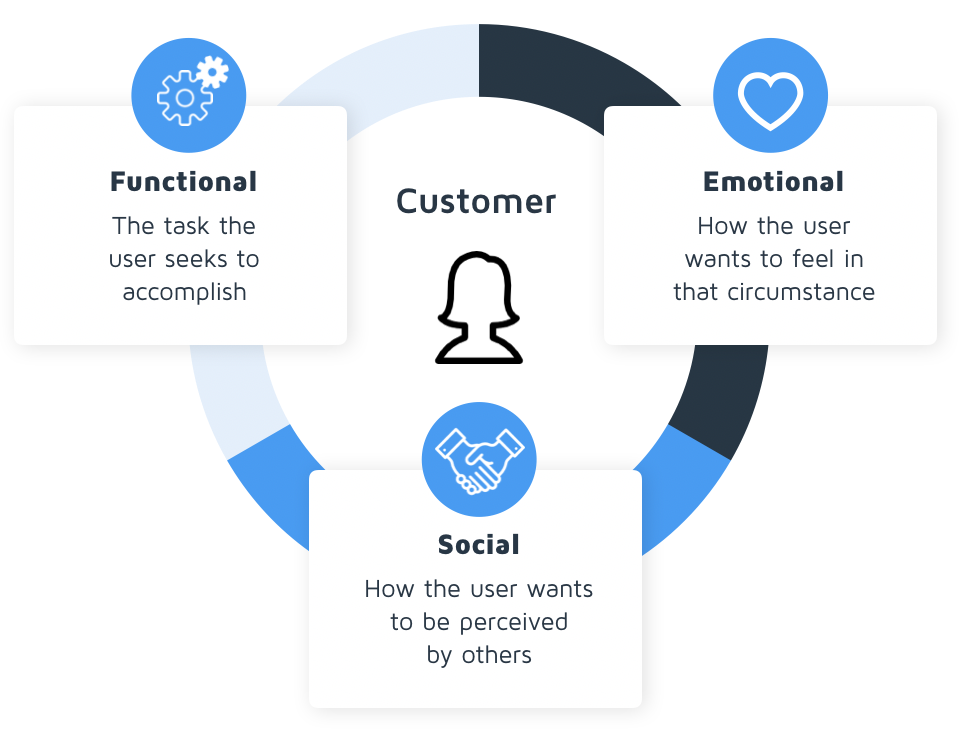
Jobs To Be Done distinguishes between different dimensions of progress. Functional jobs address practical outcomes, such as completing a task faster or reducing errors. Emotional jobs relate to how a customer wants to feel, such as confident or in control. Social jobs concern how customers want to be perceived by others. Most meaningful buying decisions combine all three.
The mistake is treating emotional and social jobs as secondary. Products that focus only on functional performance often lose to alternatives that better address anxiety, confidence, or status. The strategic question is not which job type matters most, but how they interact in a specific situation.
- Functional jobs explain utility.
- Emotional jobs explain preference.
- Social jobs explain signaling and credibility.
Strategic applications in marketing and growth
When applied rigorously, Jobs To Be Done influences multiple marketing disciplines. Positioning becomes clearer because messaging aligns with moments of struggle rather than abstract benefits. Content strategy improves by structuring pages around real intent instead of keyword lists. JTBD turns marketing outputs into decision support.
The main trade-off is depth versus speed. JTBD requires qualitative insight and disciplined synthesis, which can feel slower than assumption-driven execution. Teams that commit, however, often reduce waste across SEO, CRO, and product development because decisions share a common logic rooted in customer progress.
- SEO content maps to situations and intent.
- Landing pages address anxieties and trade-offs.
- Product roadmaps prioritize unresolved struggles.
Common misconceptions and misapplications
The most frequent error is using Jobs To Be Done as a rebranded persona template. Teams label jobs but still anchor decisions to demographics or channels. JTBD is a strategic lens, not a worksheet.
Another common misconception is assuming one job per product. In reality, products often serve multiple jobs in different contexts, which forces prioritization. Attempting to address all jobs simultaneously leads to diluted positioning and unclear messaging.
Example Case
A B2B SaaS company offering analytics tools struggled with low conversion rates despite strong traffic. The team initially framed its audience as “data-driven marketers” and optimized messaging around features and dashboards. Research showed that many visitors were not seeking deeper analytics, but reassurance that their reporting would hold up in internal discussions.
The team chose to reposition around the job of “defending decisions with confidence.” This explicitly excluded an alternative positioning focused on technical depth for analysts. Messaging shifted toward clarity, explainability, and presentation-ready outputs.
The outcome was sharper relevance and clearer expectations. Key takeaways:
- Choosing one dominant job sharpened positioning.
- Excluding a secondary audience reduced confusion.
- Progress-oriented messaging improved relevance.
Conclusion
Jobs To Be Done delivers value only when treated as a strategic decision framework rather than a research exercise. It forces teams to move beyond customer descriptions and focus on the moments that actually create demand. The guiding rule is simple: optimize for progress, not profiles.
When every decision is tested against a clearly defined job, trade-offs become explicit and differentiation becomes defensible. This boundary is what prevents superficial adoption and turns JTBD into a durable foundation for growth.
Frequently Asked Questions
Is Jobs To Be Done a replacement for personas?
No. Jobs To Be Done explains why decisions happen, while personas describe who is involved. Personas can support execution, but JTBD should guide strategy.
How many jobs should a company focus on?
Most companies should prioritize one primary job per offering. Supporting jobs can exist, but trying to serve many simultaneously weakens positioning.
Can Jobs To Be Done improve SEO?
Yes. Structuring content around situations and intent helps pages align with real search motivation rather than isolated keywords.
Is JTBD only useful for product companies?
No. Service businesses and consultancies can apply JTBD to clarify value, scope, and messaging around client outcomes.
What is the biggest mistake teams make with JTBD?
The biggest mistake is treating it as a labeling exercise instead of changing how strategic decisions are evaluated.