Why Funnels Break in Retention Markets
The funnel assumes value creation ends once a customer converts. This assumption holds for transactional models but fails when revenue depends on continued use. Subscription, SaaS, and membership businesses earn value over time, not at the moment of sale.
The core limitation is structural blindness. Funnels have no built-in feedback loop for churn, dissatisfaction, or declining usage. When growth slows, teams push more acquisition rather than fixing friction that already exists.
- Lifetime value matters more than initial conversion.
- Acquisition-only optimization hides retention problems.
- Customer experience sits outside the growth model.
This creates a fragile system. Marketing activity increases while net growth stagnates. Costs rise, but momentum does not.
What the Marketing Flywheel Model Changes
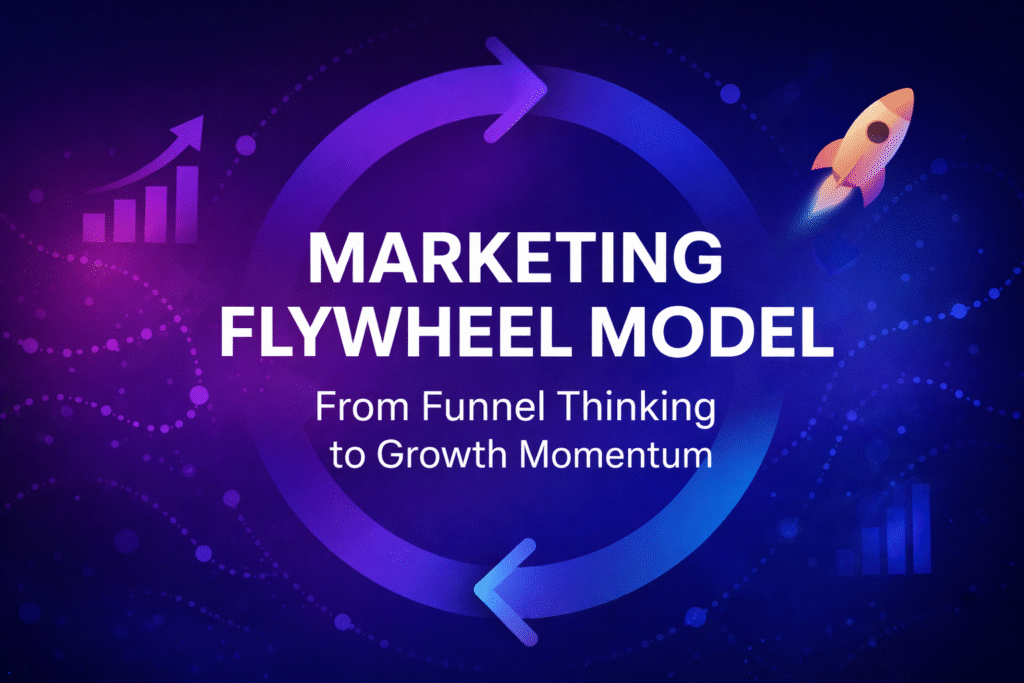
The Marketing Flywheel Model reframes growth as accumulated momentum. Customers move through acquisition, experience, retention, and advocacy in a continuous loop. Positive interactions add energy. Friction removes it.
The strategic shift is from volume to velocity. Instead of asking how many customers enter the system, flywheel thinking asks how fast and smoothly they move through it over time.
- Retention increases the return on every acquisition effort.
- Referrals lower dependence on paid channels.
- Experience quality becomes a growth input.
This model forces trade-offs. Teams must invest beyond the top of the funnel and accept slower short-term gains in exchange for compounding effects.
Funnel vs Flywheel: Strategic Comparison
The table below compares the two models at a strategic level. It highlights how each model shapes decisions, incentives, and risk exposure.
| Dimension | Funnel Model | Flywheel Model |
|---|---|---|
| Primary objective | Maximize conversions | Build long-term momentum |
| Main growth driver | New leads | Existing customers |
| Customer role | End point | Recurring input |
| Risk profile | Rising CAC | Experience debt |
| Time horizon | Short-term | Long-term |
The trade-off is simplicity versus realism. Funnels are easy to manage but ignore compounding effects. Flywheels reflect reality but require coordination across teams.
How Flywheel Thinking Changes KPIs
Metrics reveal which growth model a company truly follows. Funnel-driven teams track stage conversion and volume. Flywheel-driven teams measure energy and friction across the system.
The decision point is throughput versus flow. Throughput metrics push volume. Flow metrics reduce resistance and increase durability.
- Retention rate and churn replace lead-to-sale ratios.
- Customer lifetime value becomes a leading indicator.
- Usage, activation, and referrals gain strategic weight.
This shift often exposes incentive problems. Teams rewarded on acquisition resist metrics that pay off later.
Organizational Impact of Flywheel Thinking
Flywheel adoption changes how teams collaborate. Marketing can no longer operate as a demand engine disconnected from delivery. Product and support become growth functions.
The main implication is shared ownership of growth. Friction anywhere in the system slows momentum everywhere.
- Onboarding quality affects acquisition efficiency.
- Support interactions influence referrals.
- Product decisions shape marketing outcomes.
This requires leadership alignment. Without it, flywheel initiatives stall due to conflicting priorities.
Flywheel Friction: Where Growth Stalls
Many flywheel initiatives fail not because the model is wrong, but because friction remains unaddressed. Teams add programs without removing obstacles.
The most common mistake is stacking initiatives on broken flows. More content, more automation, or more campaigns do not fix poor onboarding or unclear value.
- Slow onboarding reduces early momentum.
- Inconsistent support erodes trust.
- Unclear product value weakens referrals.
Effective flywheel optimization starts with friction removal, not activity expansion.
When a Funnel Is Still the Better Choice
The flywheel is not always the right answer. Some business models do not benefit from long-term customer momentum.
The boundary condition is repeat value. If customers rarely return or refer, retention investment delivers limited returns.
- One-time purchases with low repeat intent.
- Short sales cycles with minimal post-sale interaction.
- Campaign-driven demand with clear endpoints.
Using a flywheel in these contexts adds complexity without improving outcomes.
Example Case
A mid-market SaaS company faced rising acquisition costs while lead volume increased. Funnel metrics showed healthy conversions, but net revenue growth slowed.
Leadership debated scaling paid acquisition or improving retention. They chose retention optimization and excluded further acquisition scaling.
The team invested in onboarding clarity, customer education, and support workflows. Churn stabilized, referrals increased, and acquisition efficiency improved without higher spend.
Key takeaways:
- Retention work can unlock growth faster than new channels.
- Excluding acquisition scaling was the critical decision.
- System health outweighed isolated funnel metrics.
Conclusion
The choice between funnel and flywheel is structural, not ideological. Each model optimizes for a different growth reality.
Use a funnel when value ends at conversion. Use a flywheel when value compounds after it. Mixing both without a clear priority leads to diluted strategy.
Frequently Asked Questions
What is the Marketing Flywheel Model?
The Marketing Flywheel Model frames growth as a continuous loop where customers add momentum through retention, experience, and referral.
Is the flywheel better than the funnel?
Neither model is better by default. The right choice depends on whether growth relies on repeat value.
Can you use both models together?
You can, but only if one clearly dominates. Equal emphasis creates conflicting priorities.
Which KPIs matter most in a flywheel?
Retention, churn, lifetime value, usage, and referral signals matter more than raw lead counts.
When should you avoid flywheel thinking?
Avoid it when customers rarely return or refer and growth depends on short-term campaigns.